Quick Answer
Quick Answer: A new central air conditioner in Denver costs $6,000-$14,000 installed, depending on size, efficiency, and features. Entry-level systems (14 SEER) run $6,000-$8,500 for a 2-3 ton unit. Mid-range (16-18 SEER) costs $8,500-$11,000. High-efficiency (20+ SEER) systems reach $11,000-$14,000. At Denver's 5,280-foot elevation, properly sizing your AC is critical - undersized units work 30% harder and fail faster. Blue Collar Heating & Air has installed hundreds of AC systems across Northglenn, Thornton, and Westminster, and we'll walk you through exactly what you'll pay and why.
What Determines New AC Costs in Denver?
When homeowners call asking "how much for a new AC," I always start with the same answer: "It depends on what your home needs." I've seen identical 2,000-square-foot homes require completely different systems based on insulation, sun exposure, and how they're built.
In the Denver metro, your new AC cost breaks down into three main categories:
Equipment (50-60% of total cost): The outdoor condenser, indoor evaporator coil, refrigerant lines, and thermostat. A basic 2.5-ton, 14 SEER system costs $3,500-$4,500 in equipment alone. Step up to a 16 SEER two-stage unit, and you're looking at $5,000-$6,500. High-efficiency variable-speed systems (20+ SEER) can run $7,000-$9,000 just for the equipment.
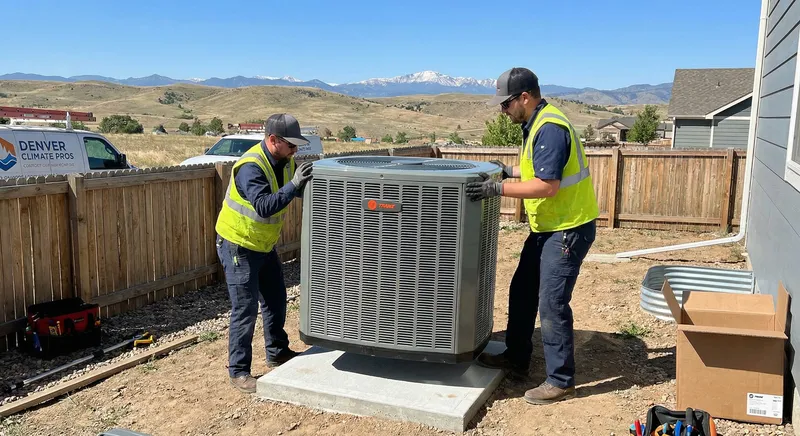
Labor & Installation (30-40% of total cost): Professional installation typically runs $2,000-$4,000 depending on complexity. This includes removing your old system, installing the new one, running refrigerant lines, electrical connections, testing, and startup. At altitude, we also adjust refrigerant charge - something generic installers often miss, leading to efficiency loss.
Additional Work (10-20% of total cost): Many homes need upgrades during installation. Older homes might need electrical panel upgrades ($800-$1,500), new thermostat wiring ($200-$400), or ductwork modifications ($500-$2,000). Denver's freeze-thaw cycles can damage concrete pads, requiring replacement ($300-$500).
The Denver Altitude Factor
One thing you won't hear from out-of-state HVAC companies: altitude matters. At 5,280 feet, air is 17% thinner than at sea level. Your AC has to work harder to achieve the same cooling. This means:
- Sizing is critical: An undersized unit that "works fine" in Texas will struggle here. I've replaced countless units that were installed by companies that didn't account for altitude.
- Refrigerant adjustment: Factory refrigerant charges are for sea level. We adjust charge based on altitude and outdoor temperature for optimal efficiency.
- Component stress: Compressors work 15% harder at elevation, which is why we recommend higher-quality units for longer lifespan.
AC System Price Breakdown: Entry, Mid, and High-End
Entry-Level Systems: $6,000-$8,500
Best for: Budget-conscious homeowners, rental properties, or homes you plan to sell within 5 years.
What you get:
- 14-15 SEER rating (minimum required by federal law)
- Single-stage compressor (100% on or 100% off)
- Basic 5-year parts warranty
- Standard thermostat
- 2-3 ton capacity for average 1,200-1,800 sq ft homes
Real talk: These units work. They'll keep you cool on Denver's hot summer days. But they're less efficient (higher electric bills), noisier, and don't dehumidify as well as higher-end models. Expect to pay $150-$200/month in cooling costs during peak summer.
Popular brands at this tier: Goodman, Amana, Rheem Classic series
Mid-Range Systems: $8,500-$11,000
Best for: Homeowners planning to stay 7+ years who want comfort and efficiency.
What you get:
- 16-18 SEER rating (30-40% more efficient than entry-level)
- Two-stage compressor (runs at low speed 80% of the time for consistent comfort)
- 10-year parts warranty
- Programmable or WiFi thermostat included
- 2-5 ton capacity for 1,500-2,500 sq ft homes
- Better humidity control (critical for Denver's dry climate)
Real talk: This is the sweet spot. Two-stage operation means the unit runs longer at lower power, removing more humidity and maintaining even temperatures. You'll notice the difference - no more hot/cold zones or that clammy feeling when the AC kicks on. Summer electric bills drop to $120-$150/month.
One thing I always tell homeowners: the $2,000-$3,000 premium over entry-level pays back in 3-4 years through lower energy costs. After that, you're saving $400-$600 annually.
Popular brands at this tier: Lennox Merit, Carrier Performance, Trane XR series
High-End Systems: $11,000-$14,000+
Best for: Forever homes, homeowners with high comfort standards, or those who want maximum efficiency and features.
What you get:
- 20-24 SEER rating (50-60% more efficient than minimum)
- Variable-speed compressor (adjusts output 1-100% for precise control)
- 10-year parts warranty + extended labor coverage options
- Advanced smart thermostat with zoning capability
- 2-5 ton capacity with superior dehumidification
- Whisper-quiet operation (60 dB or less - quieter than normal conversation)
- Advanced diagnostics and self-monitoring
Real talk: These systems are impressive. Variable-speed operation means they run at 30-40% capacity most of the time, delivering perfect comfort while sipping electricity. Summer bills drop to $90-$120/month even in large homes. They're so quiet you forget they're running.
Hidden Costs and Add-Ons to Budget For
Electrical Upgrades ($800-$1,500)
Older Denver homes (pre-1990s) often have 100-amp electrical panels. Modern high-efficiency ACs draw significant power, and you might need a panel upgrade or dedicated circuit. Not optional - it's a code requirement and a safety issue.
Ductwork Repairs ($500-$2,000)
If your ducts are leaking (common in Denver's older homes), you'll lose 20-30% of your cooled air into attics or crawlspaces. We test duct leakage during installation, and most homes need at least minor sealing. Major duct replacement can run $3,000-$5,000, but it's rare.
Thermostat Upgrades ($200-$500)
Entry-level systems come with basic thermostats. Upgrading to a WiFi model (Nest, Ecobee, Honeywell) costs $200-$350 installed and saves 10-15% on cooling costs through smart scheduling.
Financing Your New AC: What You Should Know
Here's reality: a $10,000 AC replacement is a major expense. Most families don't have that sitting in savings. That's why financing exists, and manufacturers incentivize it heavily.
0% APR for 12-24 months: Common promotional offers, especially in spring/fall (shoulder seasons). You'll need good credit (700+), but it's genuine 0% - no catch.
60-84 month payment plans: For high-efficiency systems, manufacturers offer longer terms at low rates (3-7% APR). A $12,000 system at 5% for 60 months = $226/month. That's often less than the electric bill savings.
One thing I always recommend: Don't finance an entry-level system at high interest. If you can't afford better upfront, save for a few months. Financing a premium system that saves you $500+/year makes sense. Paying 12% APR on a basic unit doesn't.
When Replacement Beats Repair: The $5,000 Rule
Not every failing AC needs replacement. Use the $5,000 rule:
System age × Repair cost = Decision point
- If your AC is 12 years old and repair costs $500: 12 × $500 = $6,000 → Replace
- If your AC is 8 years old and repair costs $400: 8 × $400 = $3,200 → Repair
Other factors:
- R-22 refrigerant: If your system uses R-22 (phased out in 2020), replacement is smart. R-22 now costs $150/pound and rising.
- Frequent breakdowns: If you're calling for repairs yearly, that's a sign.
- Efficiency: Pre-2010 systems run at 10-12 SEER. New 16 SEER systems cut cooling costs by 30-40%.
What Our Customers Say
"Lance did a great job installing a new furnace at our place. He is super responsive and always follows up with customer needs. He is great guy and dedicated technician that I would highly recommend!"
— Daniel O., Denver Metro
Google Review | 2024 | Click to see all 67 reviews
FAQ: New AC Cost Questions
What size AC do I need for my Denver home?
Most homes need 1 ton of cooling per 500-600 square feet, but Denver's altitude, sun exposure, insulation quality, and ceiling height all affect sizing. A proper Manual J load calculation is essential. Undersized units run constantly and fail early. Oversized units short-cycle, waste energy, and don't dehumidify properly.
Are high-efficiency AC systems worth the extra cost in Denver?
Yes, especially if you plan to stay 5+ years. A 16 SEER system costs $2,000-$3,000 more than 14 SEER but saves $400-$600 annually in electricity. It pays back in 3-5 years, then you're pocketing the savings. Higher SEER also means better humidity control and quieter operation.
Can I install just the outdoor unit and save money?
Technically yes, but it's a bad idea. Mixing old and new components voids warranties, reduces efficiency, and often leads to early failure. If you're replacing a system over 10 years old, replace everything - outdoor unit, indoor coil, and refrigerant lines. You'll get a matched system with full warranty coverage.
How long does AC installation take?
Most standard replacements take 6-8 hours (one day). Complex jobs with electrical upgrades, ductwork modifications, or multi-zone systems can take 1.5-2 days. We'll give you an exact timeline during the estimate.
What's the best time of year to buy a new AC?
Spring (April-May) and fall (September-October) offer the best deals. We're not slammed with emergency calls, manufacturers run promotions, and you can take time to compare options. Summer replacements (June-August) cost 10-15% more due to demand, and wait times stretch to 1-2 weeks.
Conclusion
A new central AC in Denver costs $6,000-$14,000 depending on efficiency, features, and your home's specific needs. Entry-level systems ($6,000-$8,500) work fine for basic cooling. Mid-range two-stage units ($8,500-$11,000) deliver the best value for long-term homeowners. High-efficiency variable-speed systems ($11,000-$14,000+) maximize comfort and minimize operating costs.
At Blue Collar Heating & Air, we've been helping Denver metro families choose the right AC system for over 20 years. We'll provide honest recommendations, transparent pricing, and quality installation - no high-pressure sales tactics, ever.
Ready for a free estimate? Call us at (303) 351-1667 or fill out the form below. We'll assess your home, explain your options, and give you an exact price - same day or next day service available.
Ready to Get Help?
Blue Collar Heating & Air serves Northglenn, Thornton, Westminster, and surrounding areas.
Or call directly: (303) 351-1667